
I’m a product designer who treats design as a business tool: for revenue, leverage, and long-term market power.
Benjamin Prigent,
Product Design Lead
What I work on today
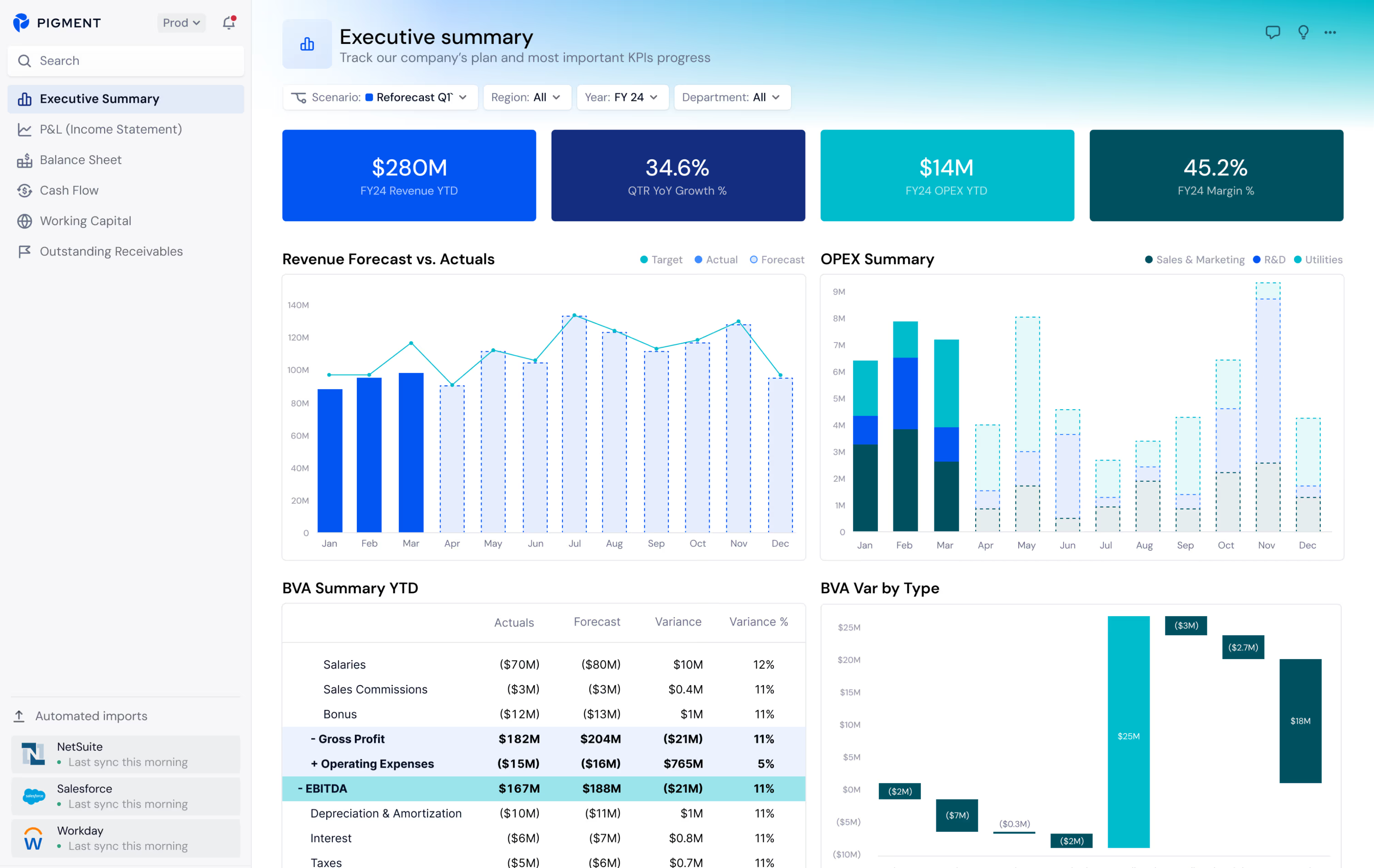
Today I’m a Product Design Lead at Pigment, where we build AI agents for the world of EPM and FP&A. Alongside design, I code often. It keeps me close to the product, and it makes me a better collaborator with engineers.
Outside of my day job, I take on a small amount of freelance work: building websites and running digital ads, mostly for people around me in my local community (I live in a small town in Bretagne).
Pigment Platform
What I believe about building products
Product principles
Design must account for both the problem and the goal: User problems matter, but solving symptoms without understanding the underlying goal leads to local optimizations and global failure. I care as much about why a problem exists as how it manifests.
Design should follow a scientific process: Every initiative should start with a clear hypothesis. What we want to change, which metric it should impact, and why we believe it will. A good experiment creates learning regardless of the outcome.
Design must ladder up to revenue: KPIs are useful only if they connect to revenue with as few hops as possible. If the link is too indirect, the signal is usually weak.
Design is inherently collaborative: No meaningful product is built alone. Good design creates clarity that allows many people to contribute strategically and tactically, and still move in the same direction.
More choices equals less action. People don’t like comparing options; they like clear answers. Reducing choices is often the fastest way to unlock movement.
Execution principles
Today, not one day. Vision is easy, in my opinion. The hard part is deciding what single outcome matters today. Progress is about outcomes, not output.
Only good passes. Work only matters if it can be handed off in a way others can act on. If it can’t be used, it’s not finished.
Money is good. Power is better. Short-term revenue keeps the lights on. Long-term advantage—moats, lock-in, structural leverage—is what makes a product resilient.
Shitty experiments over great features. Getting the problem right is more important than perfecting the first solution. Fast, imperfect experiments beat polished guesses when truth is still unknown.
Building from 0 to 1
2016, Ease, France
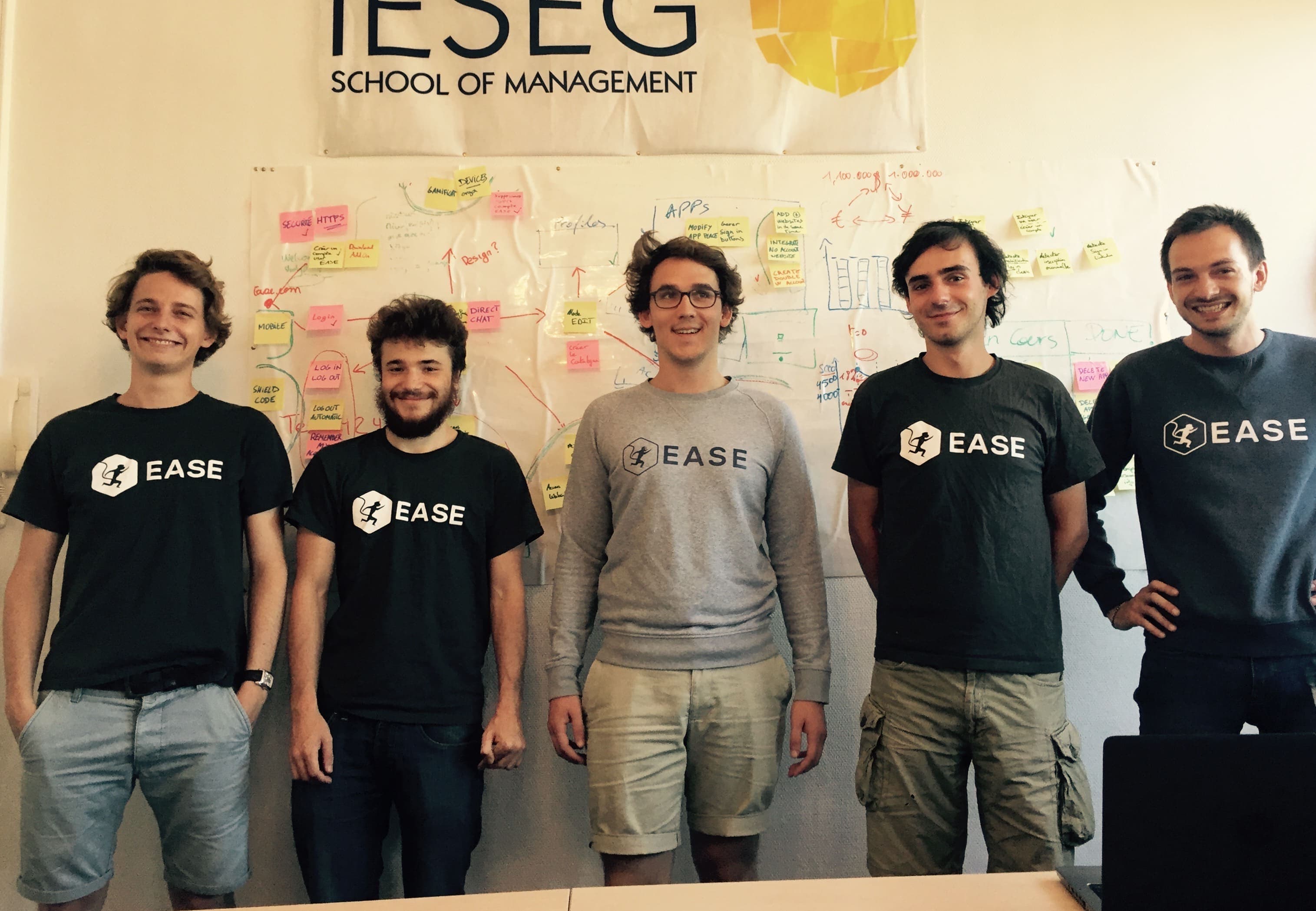
I started building companies during university. The first was a small hardware refurbishment and repair business. We worked with tight margins and real operational constraints. A year after creation, we were selling the business to a competitor for a small profit. Later, during my master’s, I co-founded a password management startup for small and mid-sized businesses. This business went further. We raised funding, hired a team, and operated the company for two and a half years before eventually shutting it down.
These two experiences taught me how unforgiving early-stage work is. Speed wasn’t a preference, it was a requirement. We moved fast not because it was exciting, but because everything was scarce. We had to learn quickly what mattered and ignore what didn’t. I also learned about altitude: one day I was working on a multi-year narrative with investors. The next, I was deep in execution, designing flows to make a safety product usable for non-technical users. When the second company stopped, I learned about another reality: resilience. In early-stage environments, “no” is the default response, dead is the default state.
One year later I joined a venture studio that specialized in building startups while co-investing with large enterprises. There, my two biggest clients were Colgate and KraftHeinz. My time there taught me a structure for innovation: how to decompose business ideas and product into their different parts (desirability, viability, and feasibility), turn these components into hypotheses, prioritize and then test them cheaply.
Across all these experiences, an operating principle progressively emerged. The product designer’s role is not fixed, it changes depending on what the team is trying to validate: a problem, a value proposition, a feature, a business model, or a growth mechanism.
Building at scale

2023, Meta, NYC
I spent three years at Meta. In my first year, I worked on Ads and helped advertisers create WhatsApp ads more easily. That work opened new use cases for close to 10 million advertisers. In my second year, I moved to the Facebook app and worked on a new way for people to discover subscriptions. We improved conversion to the payment page by 41% (the largest conversion win of my career). In my third year, I was promoted to design lead and moved teams to own a suite of products inside the Meta browser. Multiple of those products improved ad score, the core KPI my team ran on.
Those three years taught me a lot, but the biggest lesson was what working at scale actually means. Meta is large enough that even when you find a real problem to solve, it may not matter if the revenue impact is too small. An additional $10M a year barely registers when the goal is $2B. In that environment, you can’t follow startup advices like “do one thing really, really well.” You have to think differently and look for systemic problems, meaning issues that compound across Meta apps, advertising goals, advertiser industries, user flows...
I also learned how much process shapes outcomes. I saw strong processes that gave teams room to explore new ideas, kept products coherent, and acted as coordination mechanisms. I also saw weak processes that turned every decision into a co-building exercise and created inertia.
Finally, I learned how organizational structure impacts delivery. My last team was Meta’s Browser org, split across multiple sub-teams. Some were platform teams, focused on enabling others. Some were innovation teams, dedicated to riskier bets. Others were core product teams, responsible for incremental improvements on cash-cow features. That kind of structure isn’t accidental, it’s what allows different types of work to matter and different types of thinkers to thrive.
My learning loop
For me, learning has always been constant. Not as a hobby, but as a necessity to develop the expertise required to operate well.
In my first company, I learned smartphone repair through YouTube because the business needed it. In my second company, I learned how encryption mechanisms actually worked because building and selling a security product to CTOs required it.
Learning is also practical. When I became curious about e-commerce, I built several sites, first as a volunteer, then as a freelancer. Later, I worked with a financial trader, coding quantitative trading strategies with him. Today, in my current context, I’m building AI tools using various LLMs and agentic frameworks.
I also learn in public and with others. I studied business and economics at school. When I wanted to become a designer, I went to a design bootcamp. When I wanted to code, I took online classes. I write regularly on my blog, which I treat as a personal test: if I can explain a topic clearly, I probably understand it.

By Rohit Choudhari, Unsplash
Immersing in different cultures

Jordan
Between the ages of 15 and 30, I spent close to nine years living abroad. I lived in the United States, Cambodia, South Korea, Switzerland, and later Canada.
It started during high school, when my parents motivated me to move to the US alone for a year. That's where I started "building" things for the first time. My host father and I repaired bicycles in the garage (better, I watched him do it), then I sold them for a small profit. It was simple, but it made work tangible.
When I came back to France, I was more aware of the advantages I had and more driven to make use of them. So I went to university. I luckily ended in a place where international exposure was part of the curriculum. This led me to work in Cambodia, South Korea, and Switzerland, all in the span of 3-4 years.
After my entrepreneurial phase, I moved to Canada, where I spent six years. That period consolidated patterns that had already started: being comfortable operating outside of my context, pay attention to context, be cautious about one-size-fits-all solutions.
All in all, it reinforced a simple idea: people are rarely the problem, systems are.