
Purpose of this article and sources
As designers, we use numbers to assess the improvement of our work: funnel conversion, page views, clicks... We iteratively change a user journey and when our KPI improves, we attribute success to the last modification.
As designers, each new idea we have for a UX improvement comes from somewhre. This article offers a new source of UX improvement ideas: the field of behavioral science. The primary source of this article is Neuro Web Design by Dr. Susan M. Weinschenk. An amazing book I strongly recommend.
In this article, we will go over three major behavioral mechanisms: Normative Social Influence, Indebtedness, and Scarcity. We will study UI elements like Ratings and Reviews, Recommendations, Reciprocity Situations in Social Networks, Rewards, Search Results, and Product Pages.
Normative Social Influence in user interfaces
Normative Social Influence says that we have a natural tendency to seek the validation of a social group (not any social group, but more on that later). In other words, we want what other people close to us want. In digital interaction design, Normative Social Influence can be leveraged using the following UI elements: ratings, reviews, and recommendations.
Ratings & reviews real UI examples
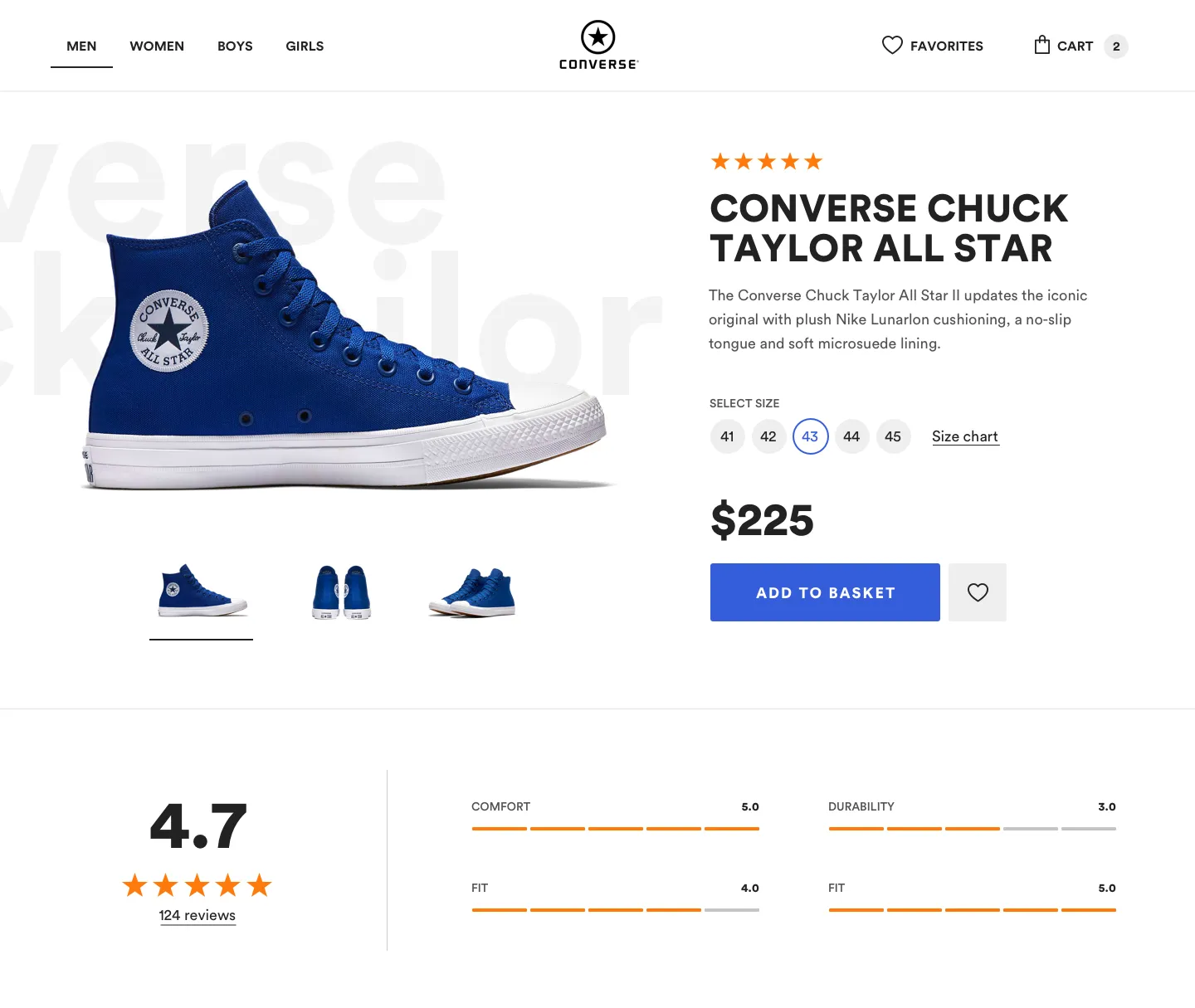
Grades and reviews are an important aspect, but they only appeal to our logical brain. Below for examples, the designer is trying to improve the conversation rate of this page by adding sub-ratings. This design adds value from a logical-brain stand point, but doesn’t give any information about who are the people behind the ratings.
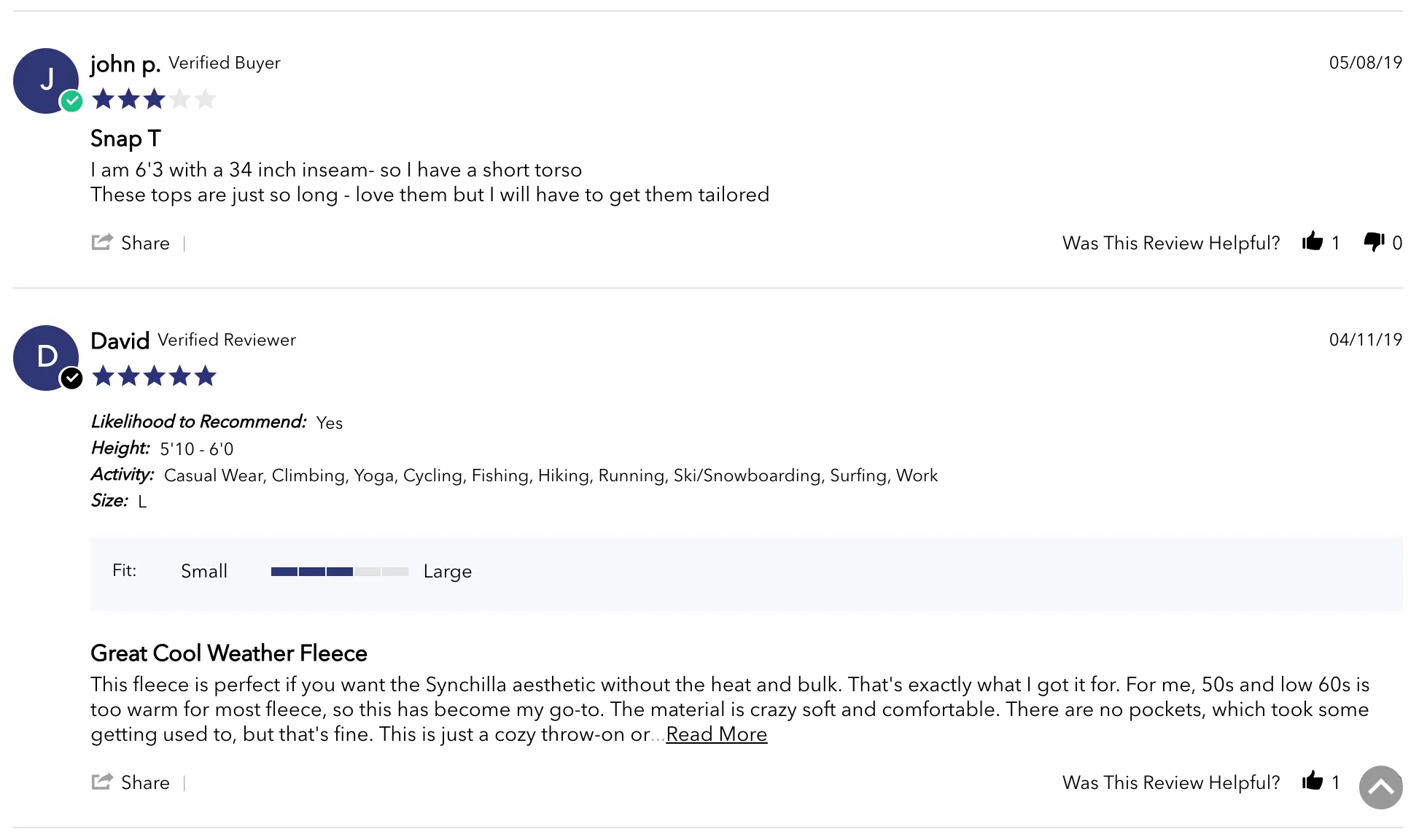
With Normative Social Influence, what matters is our relationships with the people behind the grades & reviews. Below is an example from Patagonia, they are doing something very different by getting personal: reviewers are encouraged to share personal information other people can relate to: height, shirt size, favorite activities (climbing, cycling, running, etc).
Recommendations
Displaying related products is another way to activate Normative Social Influence. It is less direct than ratings but it works all the same. Building high-conversion recommendations comes down to how you title the section. A recommendation that comes from your users will be stronger than one coming from your company.
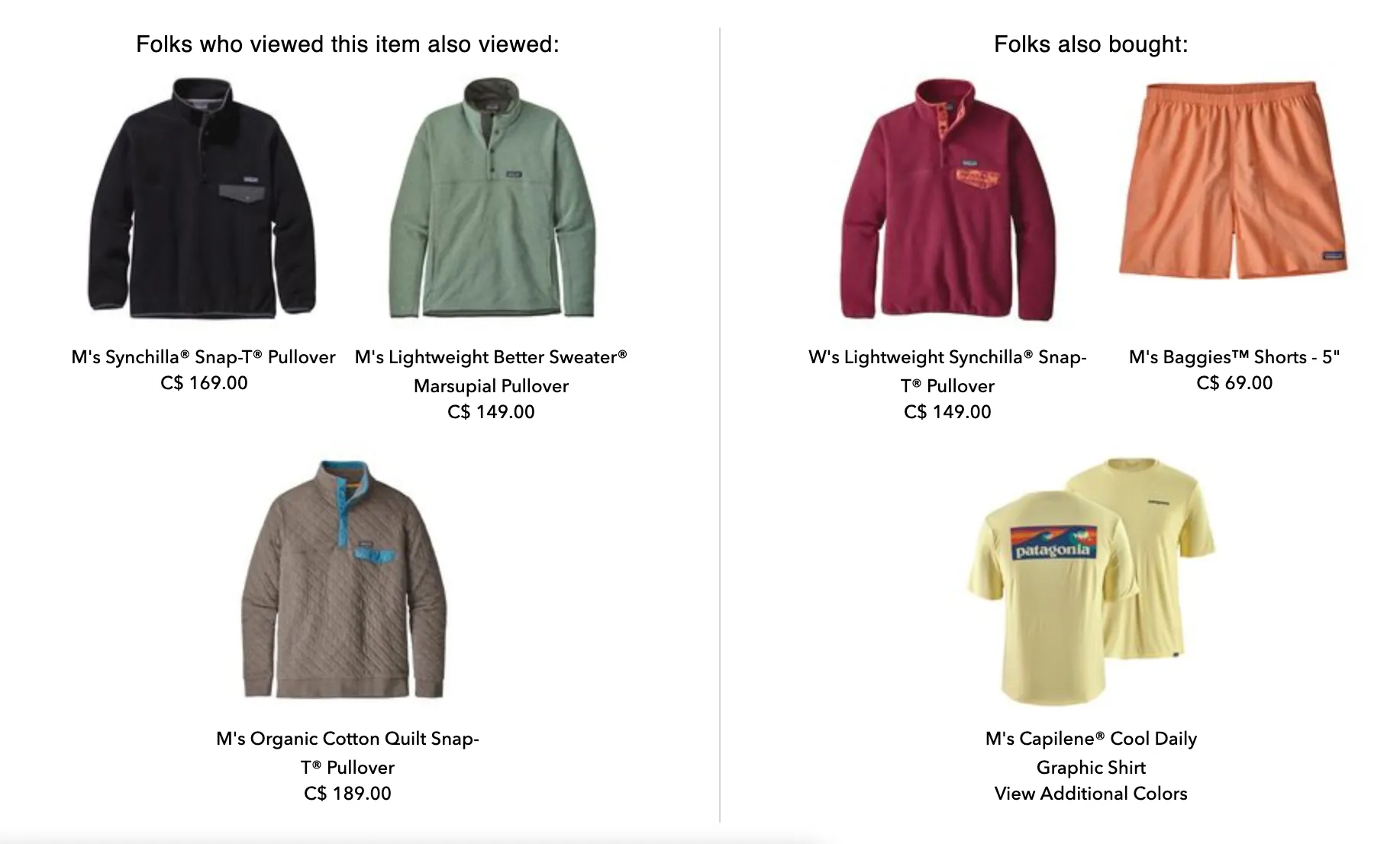
Notice how Patagonia uses the term “folks”, which implies a relationship between their users. The brand also has two recommendation sections side by side with two distinct UX purposes. The first category helps people discover. The second category is about improving the cart size. Again, both sections ground the user in Normative Social Influence by using the term "folks".
To sum up this concept, both ratings and recommendations can trigger it. Good ratings and reviews only appeal to the logical side of our brain and are not enough to trigger us into action. The leverage is stronger if users feel they receive advice from:
- Someone real
- Someone they know
- Someone similar to them (taste, interests, looks…)
- Someone they look up to
The Feeling of Indebtedness in UX
Indebtedness is the psychological mechanism explaining our natural tendency to avoid being in debt to someone else. This is caused by our will to avoid a position of weakness in a social group. We tend to act to rebalance the relationship.
Research on indebtedness (Regan, 1971): Two people are in a room (one is a research participant). They are given a task (irrelevant to the research). During a break, the research participant asks if he can leave the room. When coming back from his break, he brings two cans of soda and says to the person being experimented on: “I asked if we could bring soda in here and they said yes so I brought you one”. Later, the research participant asks the other person: “would you be interested in buying raffle tickets?”. Results: the people that were given a soda were 50% more likely to purchase a raffle ticket.
As you can see, indebtedness is powerful phenomenon and triggers us into action. There are different ways to leverage indebtedness in UX design. We will explore the two main ones: Reciprocity Situations and Rewards.
Reciprocity situations
Designers activate indebtedness by building UIs where Reciprocity is encouraged. Reciprocity occurs when you are gifted something and it pushed you to give something back.
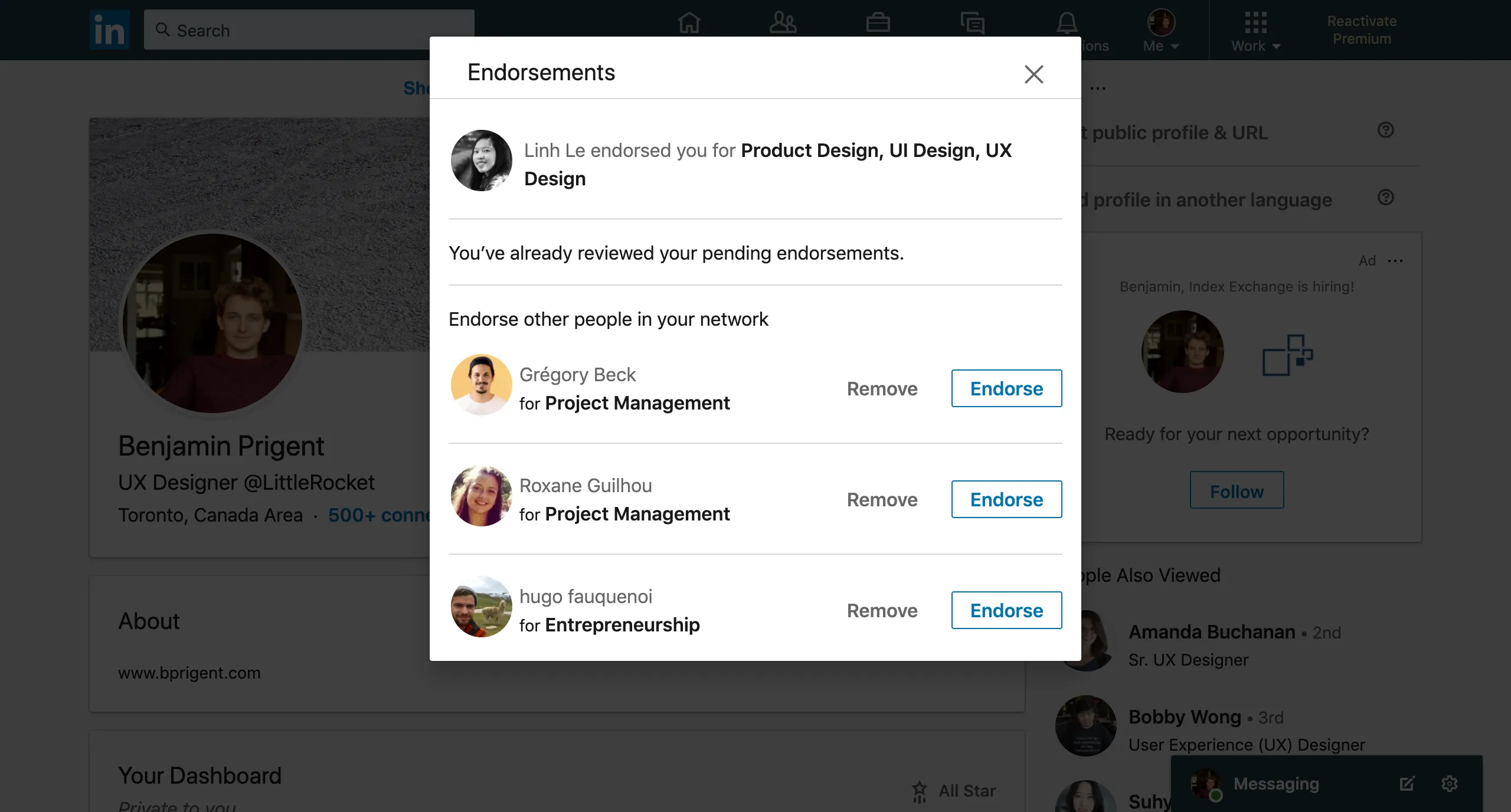
On LinkedIn, you receive a notification when someone endorses one of your skills. When clicking on that notification, a popup appears. First, you see what you were given and then you are offered the possibility to endorse other people back.
Instagram does something similar. When you visit a person’s account that is currently following you, the button says “follow back” instead of “follow”. In addition to its main informational purpose (you know he/she is following you), this button triggers the idea that “following” is a reciprocal action and therefore creates a feeling of indebtedness.
**Using rewards on a customer journey: **Rewards are the opposite of reciprocity: you are asked for something first and promised to be given something in return. Rewards can be anything: companies give away shipping, swag, content, their own products, services and time in the form of free trials. Here, Hubspot is giving away an ebook in exchange for your email. The download only starts once the form is filled.
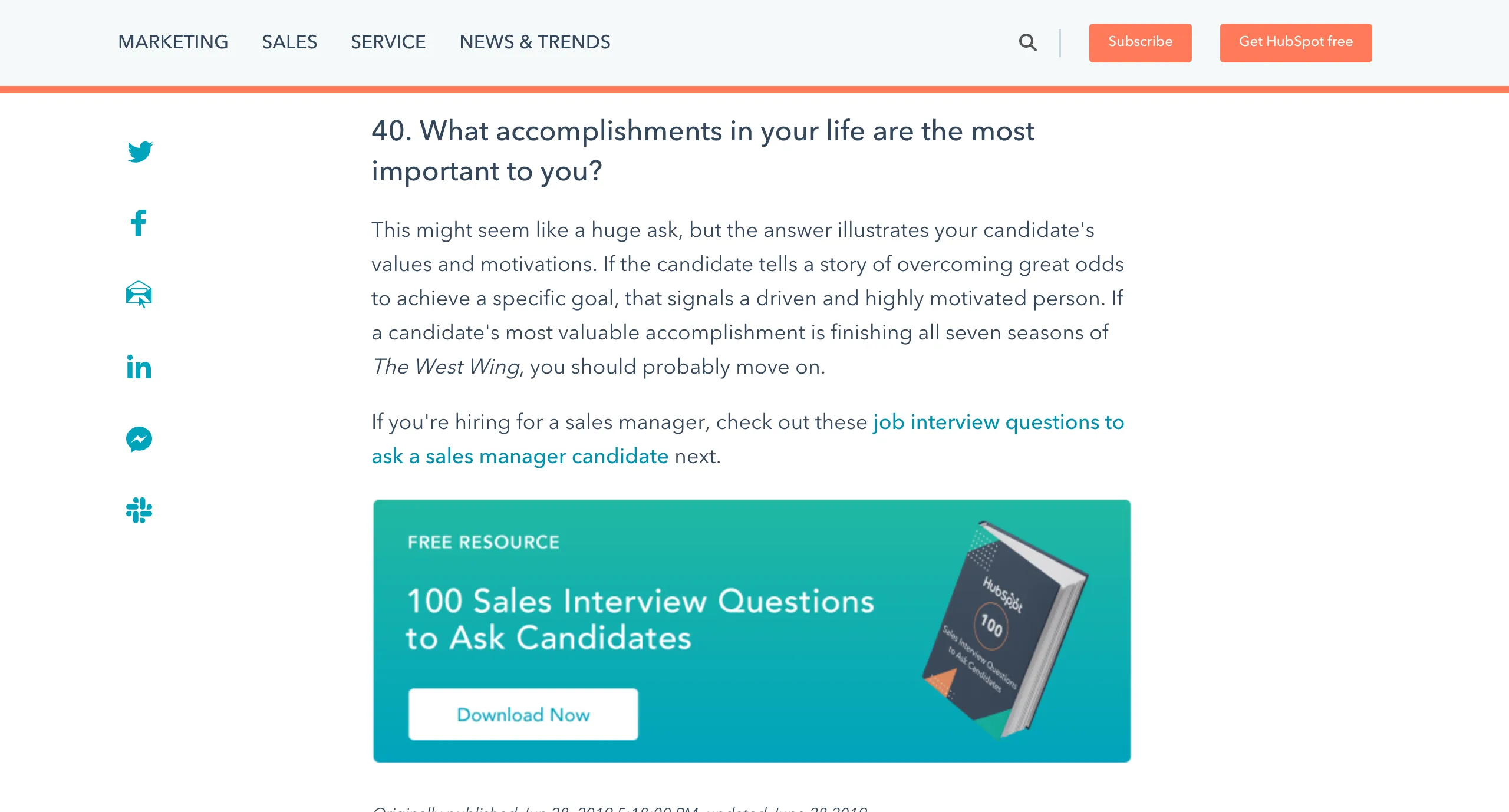
What works best between reciprocity and reward? From a business perspective, it is easier to consider using rewards over reciprocity. In fact, you can accurately forecast the cost of the operation that uses rewards because you receive before giving. Reciprocity is more unpredictable. From a design perspective though, reciprocity wins.
Study on the performance of reward and reciprocity (Gamberini et.al. 2007): On a website that provided information about files (type, loading time, etc). They A/B tested visitors to compare the effect of reciprocity and rewards. The first group had to fill a form with their demographic data before getting access to the information. The second group could access the information first and was later asked to fill the form. Result: in the reciprocity case, people were twice as likely to fill the form.
Scarcity in Product design
Defining scarcity
Scarcity is not only about tangible products. Time can also be used to convey it: “this offer ends today.” and scarce information will also be perceived as more valuable.
Study (Worchel, Lee, and Adewole 1975): they put out 2 jars of cookies. Jar one contained 10 cookies and jar two contained 2 cookies. All cookies were the same. They asked people to rate the cookies from jar one compared to jar two. Result: the cookies taken from the jar with 2 cookies were systematically given a higher rating.
Scarcity is also subjective. We all have different needs therefore a product can be perceived as more rare to some of us. Sometimes, people find value in a product because of its options (a t-shirt has color and sizes, a plain ticket has dates…). Scarcity can be anticipated. For example, if you are looking at a hotel room for a specific date, and you were to see a message saying “3 people are currently looking at that hotel for the same dates”, you might want to hurry up a little.
Examples of scarcity on Booking's UI
One of the champions when it comes to leveraging scarcity is Booking. They are not subtle but if they are doing it like that, it must work. Let’s have a look at my customer journey.
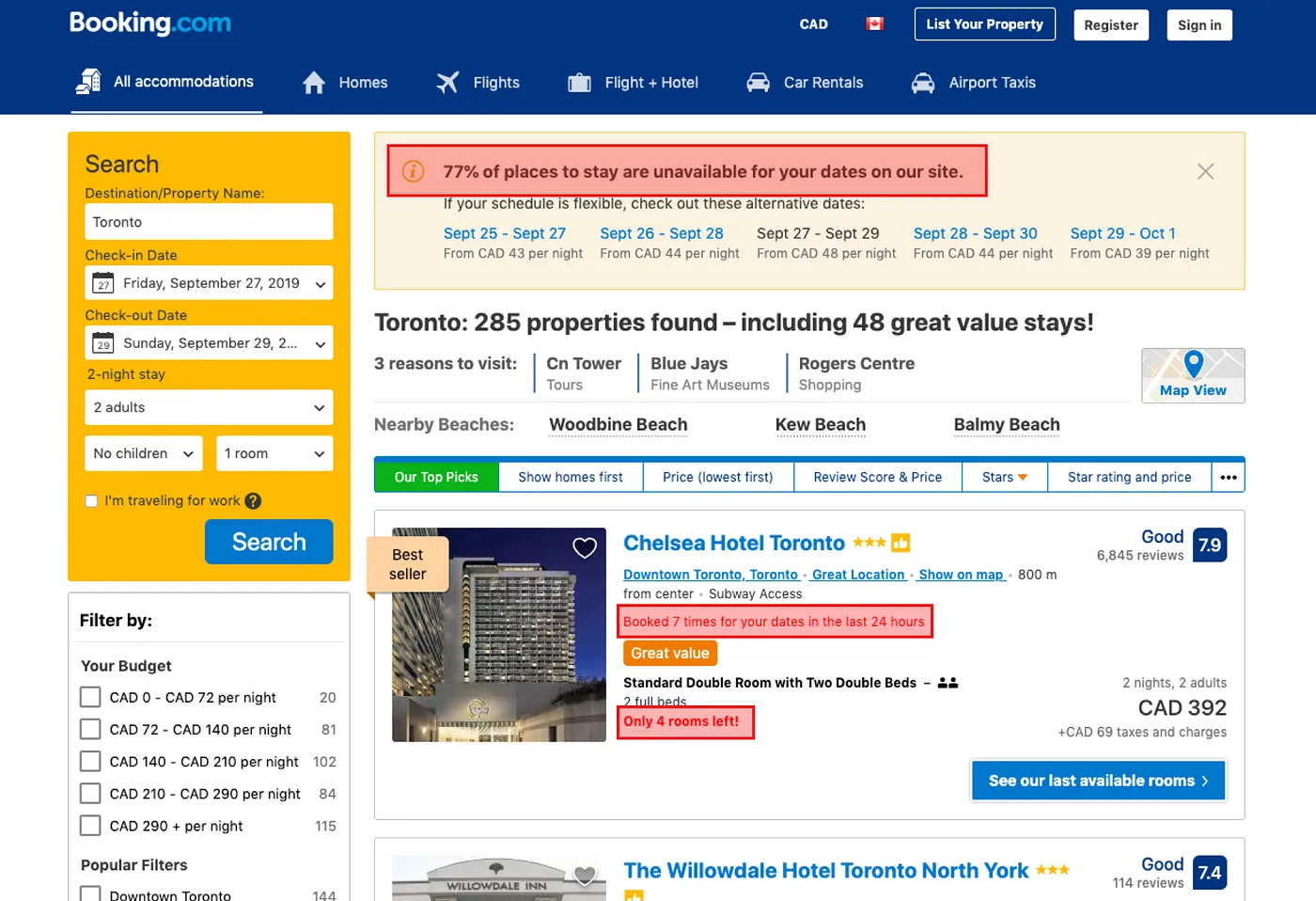
On the result page, I start by reading that 77% of the results (aka hotels) are already booked for my dates. It is even designed as a warning message. Better hurry up, my dates are popular… Then they tell me how often a hotel (a best seller on top of that) was booked in the last 24 hours. That is a good example of scarcity by anticipation. Damnnn… people are making up their mind fast... I must do the same! Then, I read that only a limited amount of rooms were available. ARGG, where is my wallet!?
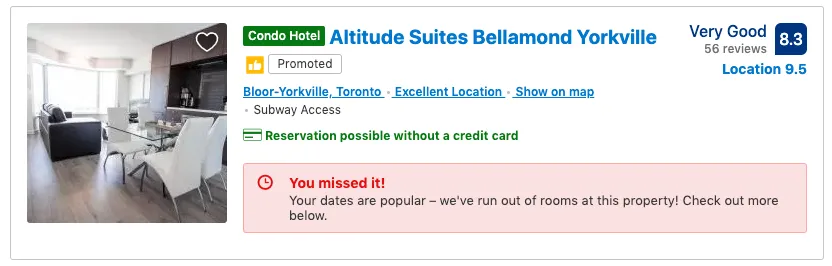
While scrolling down the results, I saw the card above repeatedly. Weird… why would they display a booked hotel? I dug a little and discovered that this card was systematically displayed every 7 results (I did other searches for other dates to check). In other words, they display booked hotels regularly so that you’ll hurry up… Finally, other scarcity markers kept appearing again and again on the hotel page.
Final thoughts on behavioral science's impact on UX
- Normative Social Influence says that we tend to do what other people do. Good ratings, reviews and recommendations will activate that trigger. Put the emphasis on who is behind them.
- The Feeling of Indebtedness says that we don’t like owing someone. You can take advantage of that feeling in reciprocity situations and by giving rewards. Reciprocity will generally work better.
- Scarcity is the nature of anything that exists in limited quantity. It is subjective and can be anticipated. Scarcity markers work better when they are tailored to the user.
Those drivers are deeply rooted within us. Is using them a form of manipulation? I think yes. Is it bad? Depends on the purpose of your customer journey. A better question may be where is the limit?